If you’ve ever watched a modern war film and felt the cold, metallic tang of authenticity hit you right in the chest, chances are you have Act of Valor to thank. Since its release in February 2012, the Relativity Media production has carved out a unique, almost mythical reputation—not for its screenplay, but for the raw, unfiltered nerve it exposed in the making of combat cinema. Fast forward to 2026, and the industry still looks back at the film’s audacious choices with a mix of awe and a little bit of head-shaking disbelief. Using active-duty U.S. Navy SEALs as the lead cast was one thing. Firing live ammunition in action sequences? That was something else entirely.
The movie didn’t just break the fourth wall; it bulldozed it. Back then, directors Mike McCoy and Scott Waugh weren’t coming from a Hollywood background—they were stunt experts and documentary filmmakers who wanted to capture something honest. Together with cinematographer Shane Hurlbut, already known for his muscular work on Terminator Salvation, they set out to craft the closest thing to a "fly on the wall" documentation of SEAL life without strapping a GoPro to an operator’s helmet. The result was a feature that blended cinema vérité with high-octane set pieces, risking life and limb in ways most insurance policies would veto immediately.
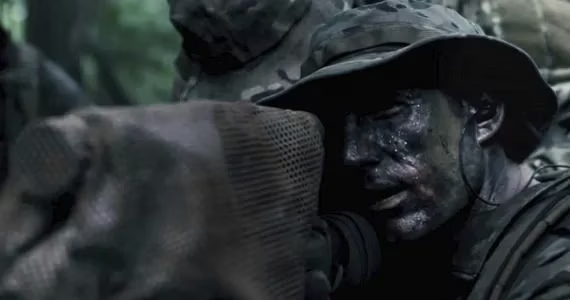
Act of Valor follows the Bandito Platoon, a SEAL team that gets tossed into a global firestorm after rescuing a kidnapped CIA operative. The mission uncovers a terrifying terrorist plot with what the script calls “potentially unimaginable consequences.” From there, the soldiers travel by air and sea across the globe, trying to stop the villains and get back to their families in one piece. It’s a classic point-A-to-point-B narrative, penned by Kurt Johnstad of 300 fame, and while the plot never tries to be a thematic meditation like Full Metal Jacket or The Hurt Locker, that’s exactly the point. The film isn’t about the psychology of war; it’s about the relentless, loud, and kinetic reality of it.
Diving deeper into what made the production so memorable—and slightly terrifying—it helps to lay out the key elements that still spark conversation in 2026. Over the past fourteen years, filmmaking technology has exploded. We have full LED volume stages, hyper-real VFX, and AI-assisted de-aging. Yet no tool has quite replicated the shaky, handheld intensity of a camera operator crouching next to live rounds. Let’s break down a few of the film’s standout production decisions and how they aged:
| Production Element | Why It Stood Out Then | Legacy in 2026 |
|---|---|---|
| Active-duty SEALs as leads | Untrained actors handling dialogue while performing actual combat drills. The facial reactions were unscripted and startlingly real. | Set a precedent for authentic casting, though most military-themed films now use veterans as advisors, not stars. The rawness remains unmatched. |
| Live ammunition in firefights | Instead of blanks, the crew used real bullets with high-grade safety coordination. The sound, smoke, and physical impact are visceral. | Hailed as a one-off marvel. Safety restrictions and union rules have all but banned the practice, making Act of Valor a permanent outlier. |
| Handheld, embedded camera style | Shane Hurlbut treated the camera like a journalist in a warzone, using small rigs to stay right inside the action. | Inspired the “observer” style seen in modern first-person shooter game cinematics and some hyper-realistic indie war films. |
| Linear, mission-focused plot | Stories about the SEALs’ personal lives were deliberately sparse, avoiding melodrama. | Seen as a refreshing change from over-explained backstories. Critics in 2026 often contrast it with today’s tendency to over-psychologize every soldier on screen. |
You might be wondering: does the film still hold up visually and sonically? Absolutely. The crack of a live round sounds nothing like a blank, and audiences still feel it. The featurette released ahead of the theatrical run—aptly named the “real bullets” featurette—shocked people even then. It showed McCoy and Waugh explaining how they wire-rigged environments and used ballistic glass to protect the crew, all while the SEALs executed tactics they’d performed hundreds of times in real life. That behind-the-scenes peek made it clear: nobody was faking it.
Looking at Act of Valor from our 2026 vantage point, what’s fascinating is how the industry’s pendulum has swung. The 2010s saw a wave of gritty realism in war films, often achieved through digital effects. But as we marched into the 2020s, a counter-movement started—filmmakers began craving the danger again. Not with live ammo, of course, but with long, unbroken takes, minimal CGI, and real military hardware. Top Gun: Maverick proved you could put actors in real jets and capture the G-forces honestly. But even that didn’t have squad members squeezing triggers with live rounds zipping past the lens. Act of Valor remains the high-water mark of "don’t do this at home" filmmaking.
In the end, the movie isn’t perfect. Dialogue from non-actors sometimes lands with a thud, and the script’s simplicity can feel like a video game briefing. But that’s almost beside the point. Act of Valor was never trying to be eloquent; it was trying to be true. And fourteen years later, it still feels closer to actual combat than anything that has followed. If you haven’t revisited it recently—or if you only know it as a meme about Navy SEAL copypasta—do yourself a favor and give the sound system a workout. You’ll hear the difference immediately, and you’ll understand why, in an age of digital everything, a little real gunfire can still shake your soul. :movie_camera::fire: