The VALORANT competitive scene was rocked in late 2026 by a high-stakes disqualification that sparked widespread debate about the boundaries of strategy and exploitation. Guild Esports, a prominent Swedish roster, saw their hard-fought victory against G2 Esports in the VALORANT First Strike European qualifier overturned and replaced with a forfeit loss. This decisive ruling from tournament organizer Riot Games came after a post-match review determined Guild had utilized a prohibited exploit to gain an unfair advantage. The result sent shockwaves through the community, as G2 Esports advanced to the playoff stage in Guild's place, raising questions about consistency, rule enforcement, and the very nature of in-game ingenuity.

The Controversial Match and the Infamous Exploit
The fateful match occurred during the play-in stage of the prestigious First Strike European qualifier. Guild Esports had earned their spot in the round-of-16 by defeating Team Queso, setting up a clash with the formidable G2 Esports, who had previously bested VASTA Gaming. The battle unfolded on the map Ascent, where Guild emerged with a seemingly decisive 13-10 victory. However, the triumph was short-lived.
Riot Games' investigation focused on a specific interaction between two agents' abilities: Sage's Barrier Orb and Killjoy's Turret. The exploit involved a player placing Killjoy's Turret on top of a Sage ice wall erected on the B site. This created an unintended boost, elevating a player high enough to gain sightlines into the critical attacker-side tunnels leading to the site—a positional advantage not intended by the game's design.
The Rulebook and the 'Intent' Debate
The core of the controversy lies in the interpretation of Riot Games' own Global Competition Policy, specifically Rule 7.2.6. This rule prohibits the use of exploits in competitive matches but notably specifies "intentional" use as the actionable offense. The rulebook also encourages players and teams to consult with tournament referees before a match if they are unsure whether a specific tactic might be considered exploitative.
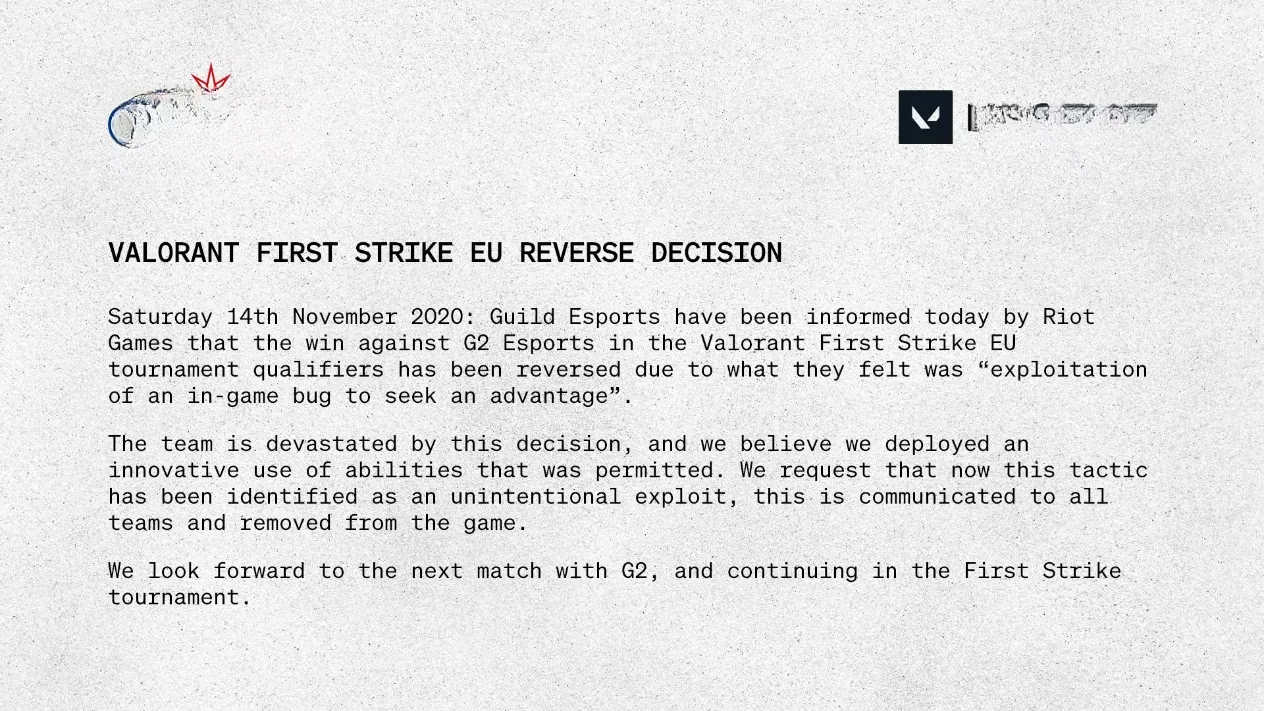
Guild Esports' official response to the disqualification hinged on this nuance. The organization released a statement expressing that the team was "devastated" by the ruling. They contended that their use of the ability interaction was an "innovative use of abilities that was permitted" and argued it should be viewed as an "unintentional" exploit. Their statement also included a request for Riot Games to address the underlying issue by removing the problematic boost from the game entirely.
Community Backlash and Calls for Consistency
The ruling ignited a firestorm within the VALORANT community. The debate fractured along several lines:
-
The 'Robbery' Camp: A significant portion of fans and analysts declared Guild's disqualification a "robbery." They argued that in a tactical shooter, creative use of agent abilities should be celebrated as high-level play, not punished. Was this truly an exploit, or was it simply a clever, if unconventional, strategy?
-
The Inconsistency Argument: Many critics pointed to perceived inconsistency in Riot's enforcement. They highlighted past instances in professional VALORANT and other Riot titles where teams allegedly used bugs or questionable mechanics without facing disqualification. This led to pressing questions: Why was this case different? Does the punishment fit the crime, or is the enforcement of such rules applied unevenly?
-
The Integrity Side: Others supported Riot's decision, emphasizing that maintaining competitive integrity is paramount. Exploits, by definition, break the intended balance of the game and provide an unfair advantage that other teams playing by the rules cannot anticipate or counter. Allowing such tactics, they argued, sets a dangerous precedent.
Key Questions Raised by the Incident
This incident forced the entire VALORANT ecosystem to confront difficult questions:
-
Where is the line between "innovation" and "exploitation"? In a game with deeply complex agent interactions, how can that line be clearly defined for competitors?
-
How can rule enforcement be made more consistent and transparent? The community's trust hinges on clear, predictable applications of the rules.
-
What is the responsibility of the developer versus the player? While players should avoid exploits, is the ultimate responsibility on Riot Games to promptly patch such interactions out of the live competitive environment?
The Aftermath and Moving Forward
As of 2026, Riot Games has not issued a public response to Guild Esports' detailed statement. The immediate competitive consequences were clear:
-
✅ G2 Esports advanced to the playoff stage of the First Strike European qualifier.
-
⚠️ Guild Esports, while disqualified from this particular event, was permitted to compete in the following week's qualifier, indicating the penalty was match-specific rather than a broader suspension.
The Guild Esports disqualification serves as a landmark case in VALORANT esports history. It underscores the growing pains of a young but fiercely competitive scene where the meta evolves rapidly, sometimes outpacing the clarity of the rules designed to govern it. The incident has undoubtedly led to more rigorous pre-match checks between teams, coaches, and referees regarding unconventional tactics. Ultimately, it highlights the ongoing challenge of fostering creative, strategic play while safeguarding the fair and balanced competition that is the foundation of any premier esport. The conversation it started about ethics, innovation, and enforcement will likely influence VALORANT's competitive policies for years to come.