Navigating the buy menu in Valorant remains one of the most critical skills for players aiming to climb the competitive ranks, even years after its explosive debut. The game's economic system, a brilliant fusion of Counter-Strike's tactical depth and hero-shooter elements, continues to be a decisive factor in match outcomes. A player's performance in the previous round dictates their financial rewards, but what truly separates the good from the great is the strategic acumen applied during the precious seconds of the buy phase. Knowing how to manage funds, whether facing a deficit or a surplus, can single-handedly swing the momentum of a game. So, how can players in 2026 optimize their purchasing decisions to secure more victories?
The Foundation: Assessing Your Resources
Before clicking that 'Buy' button, a player must conduct a quick but thorough audit of their available resources. This isn't just about looking at the number in the top corner; it's a holistic evaluation.
-
Your Cash Reserve: This is the most obvious factor. How much creds do you have?
-
Your Current Loadout: What weapon are you carrying over from the last round? A saved Operator is a very different starting point than a Classic sidearm.
-
Your Team's Economy: This is arguably the most overlooked aspect. Are your teammates rich, poor, or somewhere in between? Coordinating buys ("force," "save," "full buy") is non-negotiable at higher levels of play.
Failing to consider even one of these elements is like trying to solve a puzzle with missing pieces. You might get lucky, but you won't have a reliable strategy.
The Non-Negotiable Purchase: Shields
If there's one universal truth in Valorant's economy, it's this: Shields are not optional; they are essential. Think of them as the foundation of your survivability. In the fast-paced, one-tap meta of 2026, entering a fight without armor is a severe handicap.
-
Light Shields (400 Creds): Provides 25 armor points. This is the go-to choice for eco rounds, pistol rounds, or when funds are tight. It's a cost-effective way to survive an extra bullet or two from common rifles and SMGs.
-
Heavy Shields (1000 Creds): Provides 50 armor points. This is the premium investment for full-buy rounds. It effectively doubles your health pool against bodyshots and is crucial for surviving encounters with high-damage weapons like the Operator or the Vandal. The question isn't if you should buy shields, but which tier you can afford while still funding your primary weapon.
Strategic Buying: Reading the Game State
Your purchases should never be made in a vacuum. They must be a direct response to the ongoing narrative of the match. A rigid buying script will fail; adaptive thinking wins.
| Round Outcome | Recommended Strategy | Reasoning |
|---|---|---|
| Won the Previous Round | Full Buy / Upgrade. Purchase your best available rifle (Vandal/Phantom), Heavy Shields, and essential abilities. | Capitalize on your economic advantage. Press the lead with superior firepower. |
| Lost the Previous Round | Save or "Force Buy." Analyze team funds. If most are poor, save with Light Shields and pistols/SMGs. If close to a full buy, consider a coordinated force buy. | A save round conserves economy for a stronger future buy. A force buy is a calculated gamble to break the opponent's streak. |
| On a Losing Streak (2-3 rounds) | Consider a "Break the Bank" Force Buy. Pool resources, buy the best weapons you can (maybe a few rifles, some SMGs), and go all-in. | The goal is to steal a round, reset the opponent's economy, and stop their momentum before it becomes insurmountable. |
Agent Synergy and Ability Investment
Valorant isn't just about guns. Your agent's abilities are force multipliers. The key is to prioritize abilities that have the highest impact for your role and the upcoming round strategy.
-
Controllers & Sentinels: Should almost always purchase their core utility (smokes, traps, walls) even on save rounds. A Sage with Barrier Orb or an Omen with Dark Cover is infinitely more valuable than a Sage or Omen with a Sheriff but no utility.
-
Duelists & Initiators: Damage-dealing or entry-focused abilities (Raze's Paint Shells, Sova's Shock Dart) can be prioritized when trying to win an eco round. However, on full buys, securing your primary weapon and shields often comes first.
Remember, a perfectly placed piece of utility can be more devastating than a stray bullet. Does your team need vision, area denial, or a direct combat advantage? Let that guide your ability purchases.
Weapon Hierarchy and Situational Picks
While the Vandal and Phantom reign supreme, the 2026 meta has seen a healthy diversification. The buy menu isn't a one-click solution.
-
Rifles (Vandal/Phantom): The cornerstone of any full buy. Your default choice when money is good.
-
Operator/Marshal: High-risk, high-reward picks. Only buy when you can also afford full utility and shields, and when the map/your playstyle supports it.
-
SMGs (Spectre/Stinger): Excellent for force buys, anti-eco rounds, or aggressive second-round buys after a pistol win. They offer great value for their cost.
-
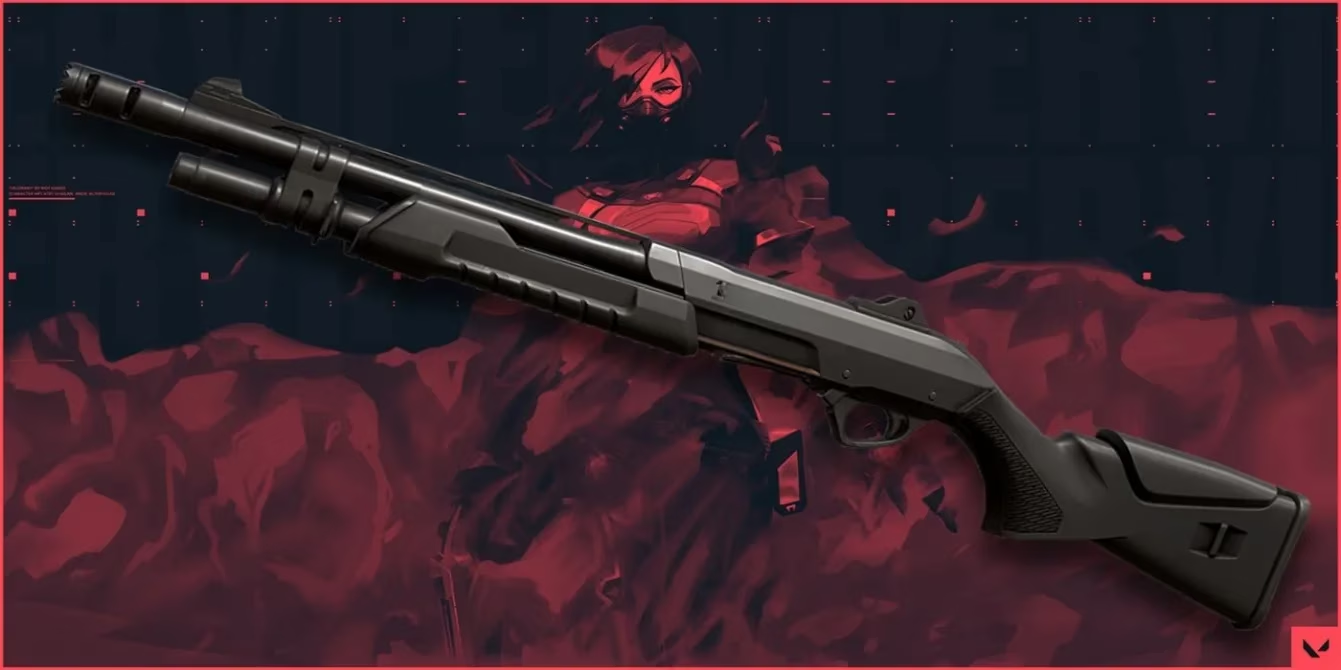
Shotguns (Bucky/Judge): Niche but powerful on certain maps (like Bind or Split) or for holding tight angles. A surprise Judge buy can dismantle a rushing team.
Final Thoughts: Developing Your Economic Instinct
Ultimately, mastering the Valorant economy is about developing game sense. It's about asking the right questions in those few seconds before the round starts: What did we just do? What is the opponent likely to do? What does my team need from me this round?
The tips outlined here—prioritizing shields, reading the round history, coordinating with your team, and valuing utility—are the pillars of sound economic play. They provide a framework to ease the pressure of that crucial buy phase. However, the final decision always rests on a blend of personal preference, agent selection, and in-the-moment tactical analysis. In 2026, the players who treat the buy menu not as a shop, but as a strategic command center, will find themselves consistently outmaneuvering their opponents before a single shot is even fired. After all, isn't winning the economic war often the first step to winning the match?