I logged into League of Legends on a humid July morning in 2026 expecting another ordinary match, only to find my chat box sealed like a jar of pickles with the lid welded shut. At first I assumed the automated punishment system had finally caught up with my late-night ARAM typing. It had not. Riot Games had quietly flipped a switch, and suddenly thousands of veteran players were standing outside the party while a bouncer stared at a clipboard, refusing to check IDs. That bouncer was Riot's brand-new parental controls system, and it was treating adult accounts as if they belonged to unsupervised children.
The tools themselves sounded reasonable on paper. The official update for League of Legends, Valorant, and Teamfight Tactics gave guardians several controls:
-
🔇 Turn text and voice chat off or limit them to friends
-
👥 Prevent sending or accepting friend requests
-
🚫 Restrict or disable access to specific Riot games
In an era when France has pushed to ban minors from social media and age verification has become a recurring ritual across live-service games, those safeguards felt overdue. But the execution landed less like a safety net and more like a net thrown over the entire ocean, catching every fish regardless of size or species.

Within hours, forums and social feeds filled with confused posts. Players reported being blocked from chat, unable to add friends, and locked out of parts of their accounts even when their date of birth clearly showed they were adults. One user said their sixteen-year-old account had been restricted with no way to disable the feature. The parental controls had spread through the player base like algae in a neglected pond—silent, green, and nearly impossible to scrape off once it blooms. My own account, old enough to drive in most countries, was caught in the same bloom. That was the moment I realized the system had not just failed to check IDs; it had never opened the gate at all.
Riot Games eventually acknowledged that the change was improperly affecting many League of Legends accounts and said it would roll back the feature on League specifically while addressing the issues. Some players also reported that the parental email verification system was not functioning properly. For a few days, the rollback felt like watching a firefighter climb onto the porch while the upstairs curtains were already smoking—good intentions, but the smoke had already spread. I could almost hear the servers sigh.
The backlash was especially loud in Valorant, which already carries a T rating from the ESRB and a 16+ rating from PEGI. League of Legends sits at PEGI 12+ with the same ESRB T rating. Many argued that imposing such sweeping parental controls on games already rated for teens created a redundant layer that did more to frustrate adults than protect children. One commenter under the announcement post pointed out something worse: the new parental system was the only existing way to block incoming friend requests. Players who wanted a quiet experience suddenly discovered that the road to peace had been paved with a tripwire.

Amid this controversy, Riot has been preparing a nostalgic olive branch: League of Legends Classic. Officially teased in June 2026, the mode is scheduled to arrive in July and will bring back old items, champions, and a previous map design for Summoner's Rift. The first iteration is based on Season 3 gameplay, featuring pre-rework versions of champions like Nidalee, Sion, and Evelynn. As someone who remembers those days, this is like finding a box of childhood toys in the attic—worn, familiar, and unexpectedly sharp around the edges. I still want to play it, but the parental controls fiasco has left a bitter taste before the first minion wave even spawns.
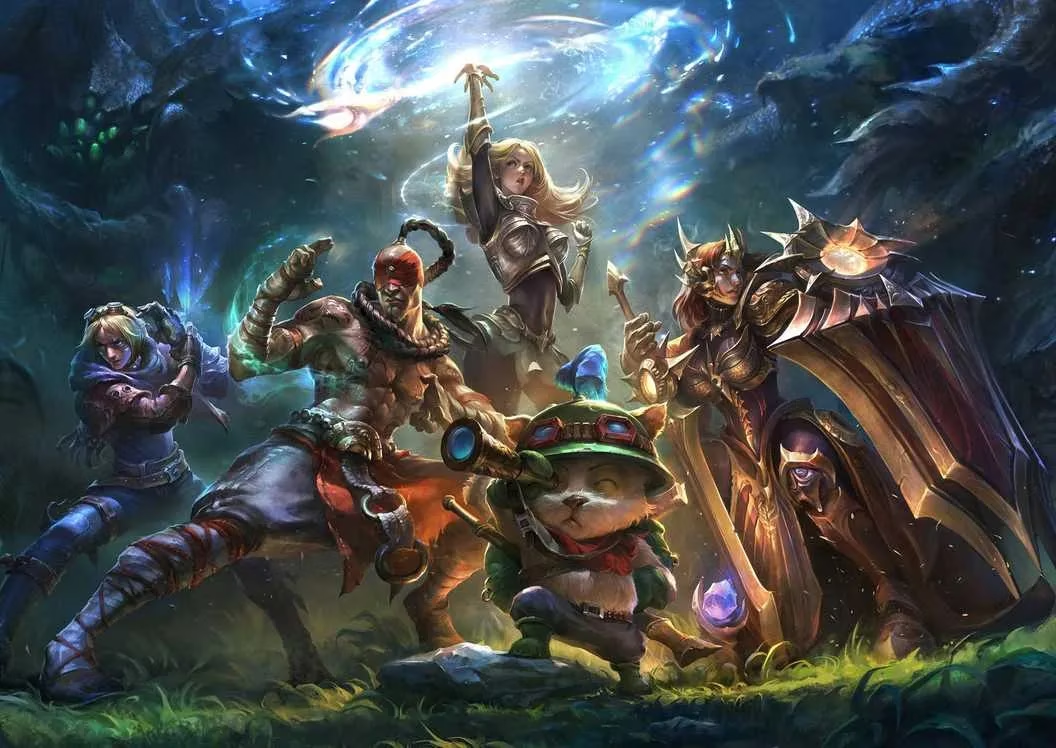
Riot Games can only hope the rollback and the promised fixes restore trust quickly. The new controls may have been built with good intentions, but the launch felt like locking every car in the neighborhood because one family forgot where they parked. If Classic is to succeed, the lobby doors need to open without a parent's permission—especially for those of us who have been playing since before some current players were born.
Data referenced from ESRB helps frame why Riot’s parental-controls rollout sparked such immediate confusion: even when a title carries a Teen rating, that classification signals content suitability rather than a platform-wide mandate to gate core social features for verified adults. In practice, mixing safety tooling with broad account-level restrictions can create a mismatch between a game’s communicated age guidance and the lived player experience—especially when essential functions like chat and friend management are impacted without clear, opt-in consent or reliable age verification.