The sun had barely crested the shuttered windows of Bind, and already the air inside the market smelled of ozone and tension. Kai—a new agent still learning to read the battlefield’s murmurs—crouched behind a battered wooden stall, his Vandal trembling in his grip. Across the courtyard, an enemy Cypher had pinned his team with tripwires and a spy camera so sharp it could make a ghost flinch. Kai’s plan was simple: sprint to the teleporter, flank hard, and surgically remove the threat. He never made it ten paces.
A burst of fire punched through the stall’s rotting planks as if they were wet paper. Kai crumbled, his avatar dissolving into blue sparks, a single question burning behind his eyes: how? The kill feed showed an Operator round from a distant tower—through three walls, a fountain, and a crate of stale fruit. In that moment, the walls themselves had turned into traitors, and Kai resolved to learn their secrets.
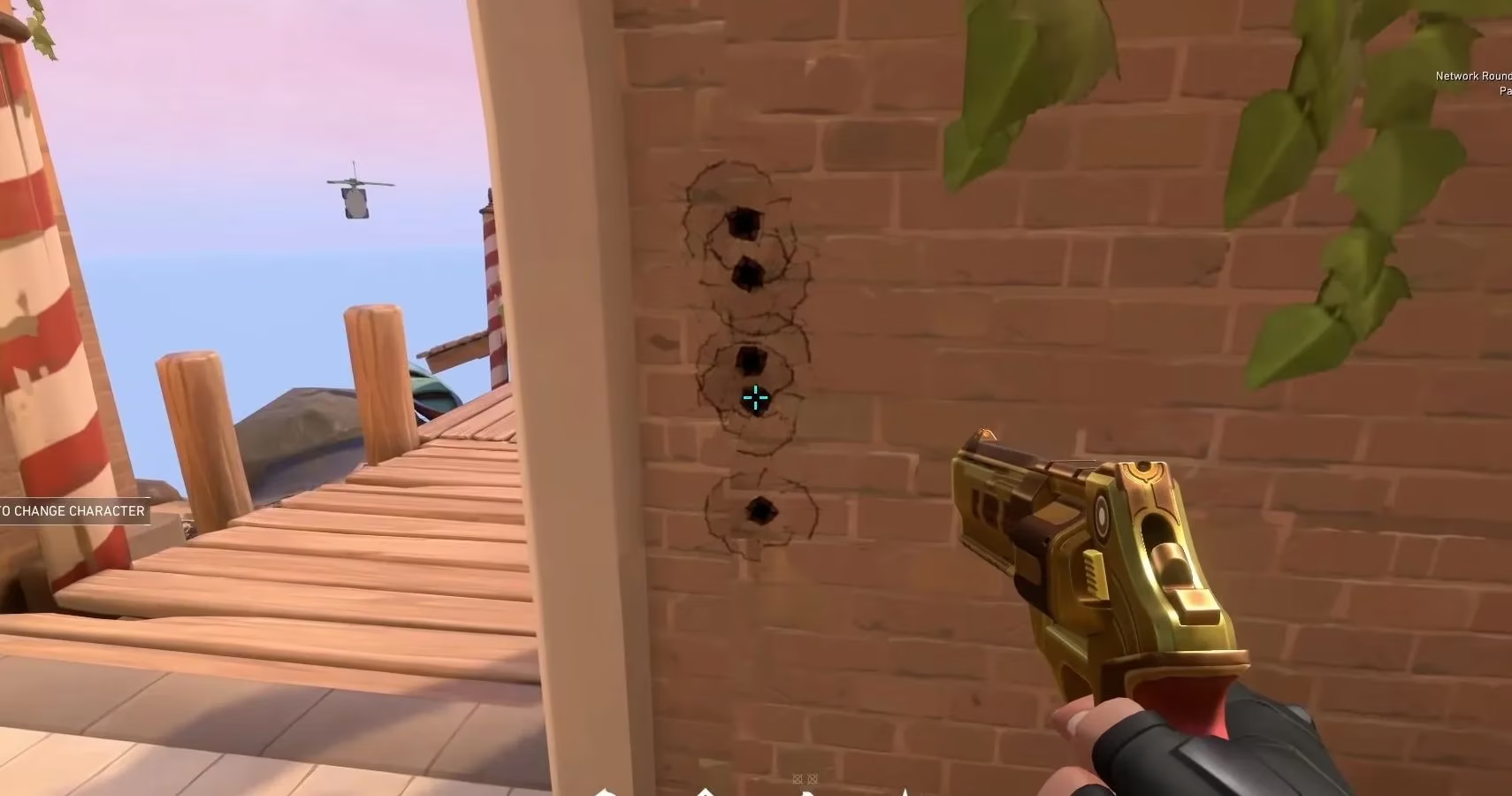
Back in the Range, Kai stood before a stark simulation of Ascent’s courtyard, flanked by material test blocks. He had already memorized the weapon tiers from the agency’s field manual: low penetration arms such as the Classic pistol and Bucky shotgun, which fired rounds as light as whispers; medium penetration tools like the Spectre SMG and Bulldog assault rifle, the workhorses that could chew through most obstacles; and heavy penetration beasts—the Operator, the Ares—whose bullets were forged with the intent to ignore anything short of a vault door. But knowing theory was like memorizing a recipe without ever tasting the dish. He had to see it.
He lifted a Classic and aimed at a slab of wood. The report was a polite cough. The wall panel drank the bullets whole, and a puff of gray smoke bloomed on the far side, accompanied by a cratered hole. Penetrated. He switched to the stone target. The Classic’s shots struck the surface and died there, spitting tiny orange sparks that danced across the rock like angry fireflies trapped in an invisible jar. No holes, only shallow scratches—each spark a whispered refusal. The orange flash meant the bullet was ricocheting harmlessly, a detail he had overheard veteran ghost operators call “the wall’s middle finger.” He remembered a scattered metaphor once shared around a campfire in the Range: those orange sparks were like a lock’s tumblers refusing a wrong key, while the white smoke and crater were the satisfying click of a door swinging open.
He traded up to a Bulldog and repeated the test. The wooden wall again yielded easily, its fabric tearing like an old bedsheet in a gale—an almost laughable performance. But now the stone wall, too, crumbled under the hail of medium-caliber fire. Puffs of white smoke erupted from the far side, and deep craters tattooed the surface, each one a small moon crater. Finally, he hefted an Operator and faced a metal barricade. The first shot screamed, and the metal peeled inward with a concussion that rattled his sternum. Where the bullet emerged, a soft white vapor curled, and a hole as neat as a surgical incision marked its exit. That, he thought, was the real language of penetration: the metal did not spark; it surrendered.
The manual had also taught him something crueler: a bullet that passed through anything—be it wood, stone, or metal—bled energy. Like a rumor traveling through a chain of gossips, its damage degraded with each obstacle. An Operator body shot through two walls might wound instead of kill, a fact that turned every wallbang into a gamble. Yet the trade was often worth it. Eliminating a foe from absolute safety, without even a glimpse of your silhouette, was the kind of asymmetric advantage that could unshackle a defender’s hold on a site.
Kai drilled for hours. He learned to recognize the subtle differences in sound when a round found flesh after a penetration—a duller thud, slightly delayed. He became an archaeologist of the death cam, rewatching every wall-banged demise, reading the crater patterns like a hunter reads tracks. The material types—wood, stone, metal—became a simple mnemonic: “Wood welcomes all, stone tolerates the middle, metal bows only to the heaviest.” He turned it into a chant, humming it as he cleared corners in his practice games.
The real revelation, however, came when he applied the visual cues in live combat. On Haven, defending C long, he watched an enemy Raze dance behind a radianite crate—a metal one. She felt safe; metal had always been her cocoon. Kai didn’t fire his Phantom. He switched to an Ares, waited for the tremor of a reload, and let the LMG roar. A blizzard of heavy rounds tore through the crate, and white smoke puffed like a distress signal before Raze’s body slumped. No orange sparks, only silent confirmation. The walls had spoken, and he had finally understood their vocabulary.
From that day forward, every bullet hole became a sentence. Low-penetration pistols left tales of frustration against stone, their stories ending in orange ellipses. Medium rifles authored paragraphs through stone and wood, their white smoke the exhalation of a wall’s last breath. And the Operator—the Operator wrote epic poems through metal, each shot a verse that erased an opponent’s confidence. In VALORANT, the walls are never truly just walls; they are a permeable membrane, a tangled code, and those who learn to decipher it become something far more dangerous than a good aim. They become a force that can strike through the secret veins of the map, turning cover into a lie.
As Kai queued for his next competitive match—now in the year 2026, where the game had evolved but its ballistic truths remained immutable—he smiled at the load screen, thinking of all the agents who still believed a wall was a shield. He no longer counted himself among them. The only safe place, he knew, was in motion, and even then, a clever enough bullet could still find you like a rumor that refuses to be silenced.